Signal Detection → Demand Intelligence → Design Validation → Governed Execution
Turn inventory and demand signals into better operational decisions. XVORA helps enterprises align product design, sourcing, and production planning with real market movement — and helps identify inventory exposure earlier, before it becomes markdown or write-off. XVORA operates as an independent AI engine built on the XSYDA signal intelligence framework.
Lower excess and obsolete inventory · better inventory positioning · improved sell-through · earlier detection of inventory exposure · stronger working-capital decisions · better alignment between design, demand, and production.
Where inventory, demand, and margin decisions get made — XVORA is designed to help enterprises make them earlier and better.
Reduce excess and obsolete stock before it becomes markdown or write-off.
Respond to demand shifts earlier, while positioning still matters.
Reduce the cost of forecasting and allocation errors that compress gross margin.
Free capital tied up in the wrong inventory in the wrong places.
Market signals, search trends, social sentiment, competitive pricing captured in real time
ML models predict demand at SKU level across channels, geographies, and seasons
Product design decisions validated against forward-looking demand before production commitment
Approved decisions flow to production with full audit trail and governance
Enterprise-grade demand sensing, prediction, and design validation
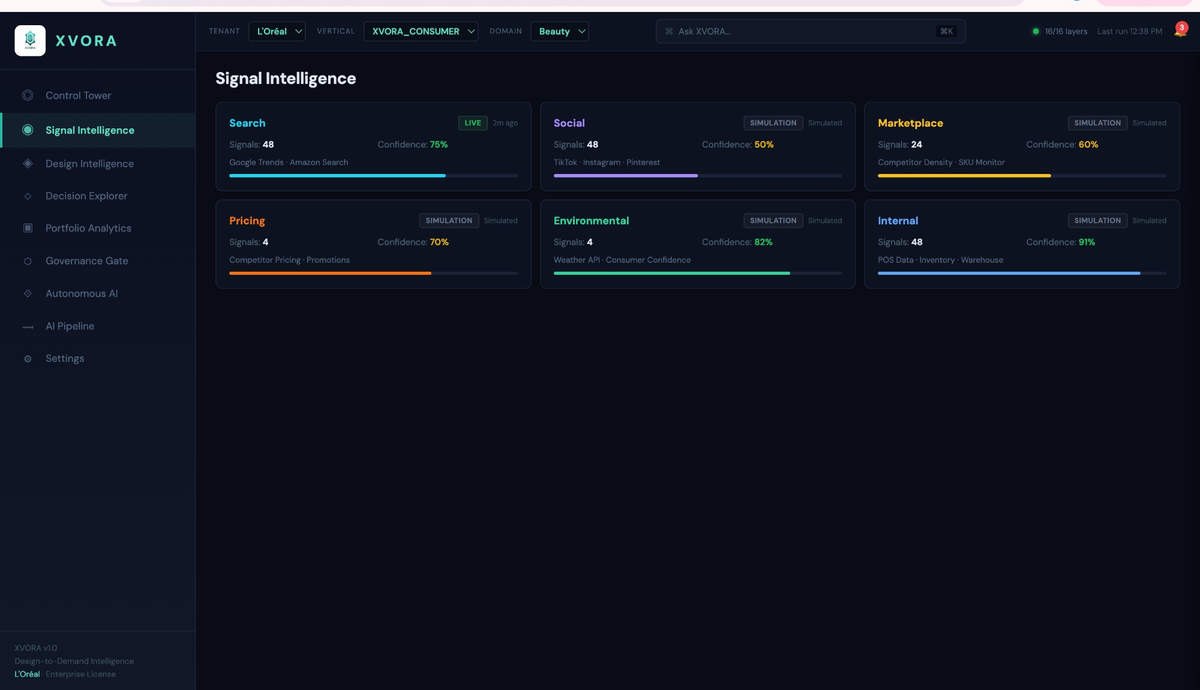
Six signal categories processed in real time — search trends, social sentiment, marketplace data, pricing intelligence, environmental signals, and internal POS data. Each with live confidence scoring.


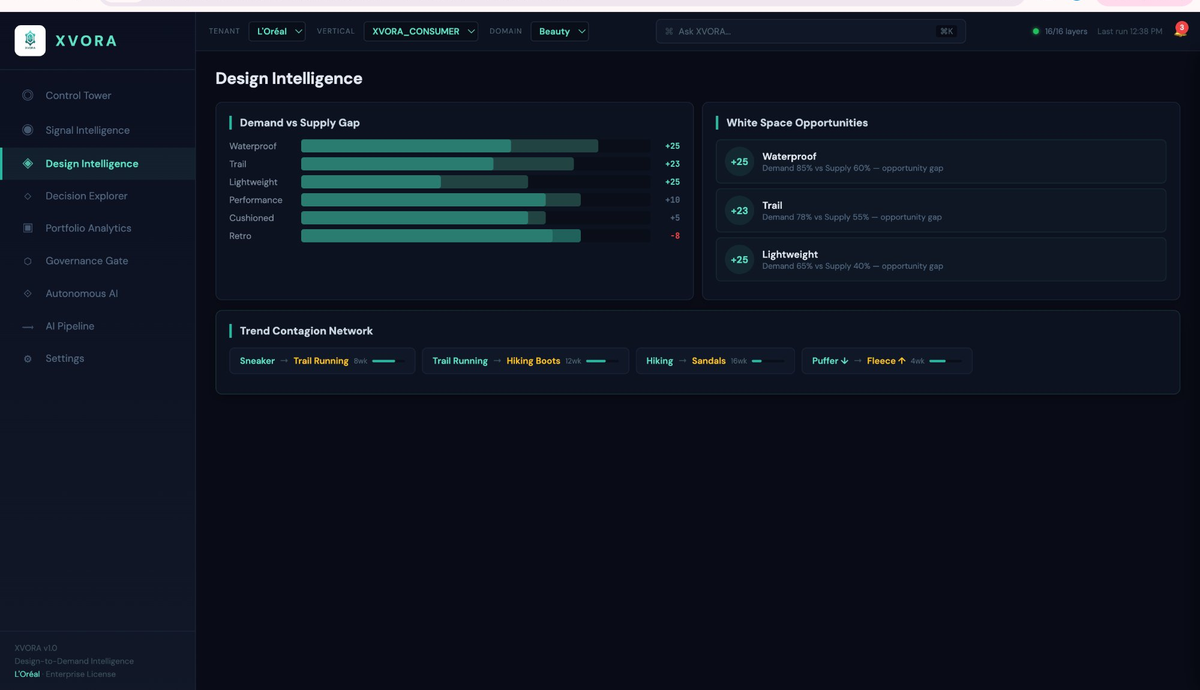
Demand vs supply gap analysis, white-space opportunity detection, and trend contagion network mapping category momentum across product lines.
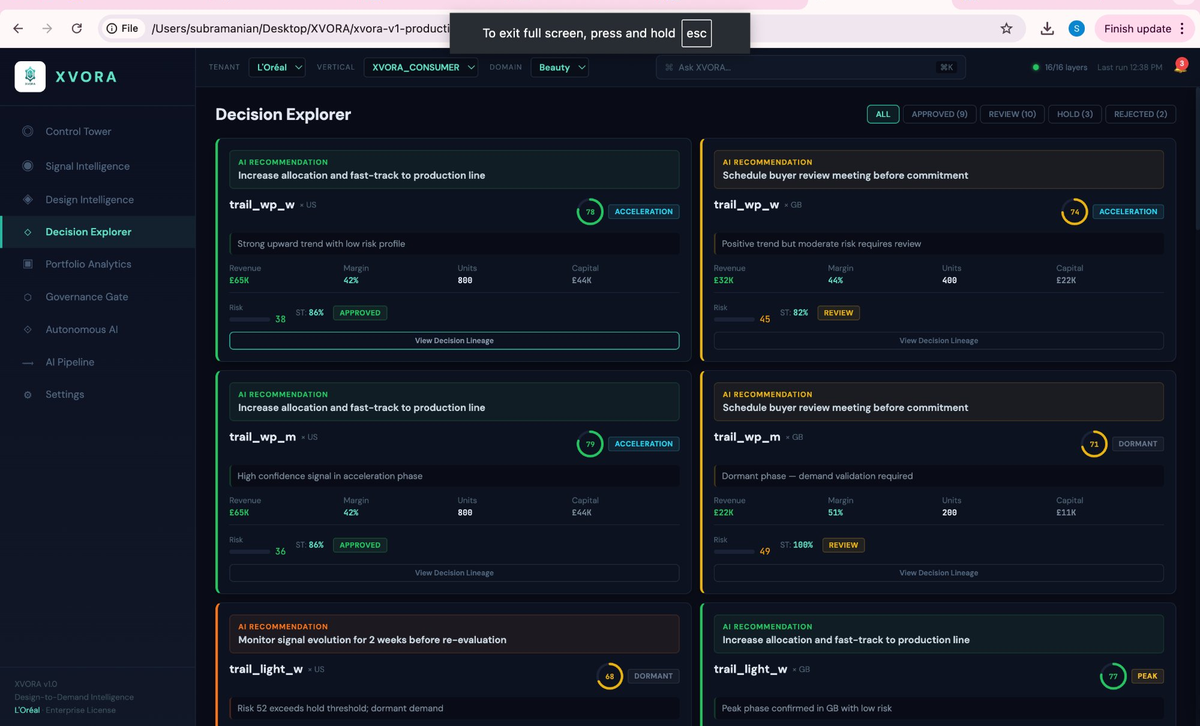
AI-driven recommendations with confidence scoring, risk assessment, and governance status. Every product decision carries deterministic logic and full decision lineage.

Real-time market signals — search trends, social sentiment, competitive pricing — to detect demand shifts before order books.
ML models trained on consumer behaviour, seasonal cycles, and market dynamics. SKU-level prediction across channels.
Continuous monitoring of competitive landscape, pricing movements, new launches, and category trends.
Identifies acceleration, phase-out, and white-space opportunities across the product portfolio.
XVORA closes the loop between design decisions and inventory outcomes.
Search · Social · Pricing · Weather
Demand prediction · Signal analysis
SKU approval · Risk scoring
Governed commitment · Audit trail
Sell-through tracking · Feedback loop
Assortment planning · Markdown optimisation · New product introduction
Model mix planning · Feature-demand correlation · Regional demand variation
Product lifecycle timing · Component demand forecasting · Launch readiness
Category prediction · Promotional impact · Channel allocation
Collection demand intelligence · Trend-responsive sourcing · Seasonal inventory risk
All models and signals process inside your infrastructure. No data leaves your environment.
Every recommendation is explainable, reproducible, and audit-ready. No black-box AI.
Policy-enforced approval workflows. Decisions require authorisation before execution.
Signal-to-decision lineage. Every data point, model output, and approval logged.
Tenant isolation by brand, vertical, and domain. Enterprise-grade data separation.
Connect to ERP, PLM, POS, and warehouse systems via REST APIs and Kafka streams.
Retail supply chains operate at the intersection of demand volatility, global sourcing networks, and real-time execution. XSYDA technologies support retail organizations by enabling early detection of demand signals, improving sourcing coordination, and strengthening execution across merchandising, inventory, and logistics networks.
Identifies emerging demand signals early enough to influence design, sourcing, assortment planning, and inventory decisions before imbalance occurs.
Connect design decisions to demand intelligence. Prevent overproduction. Govern every product decision.