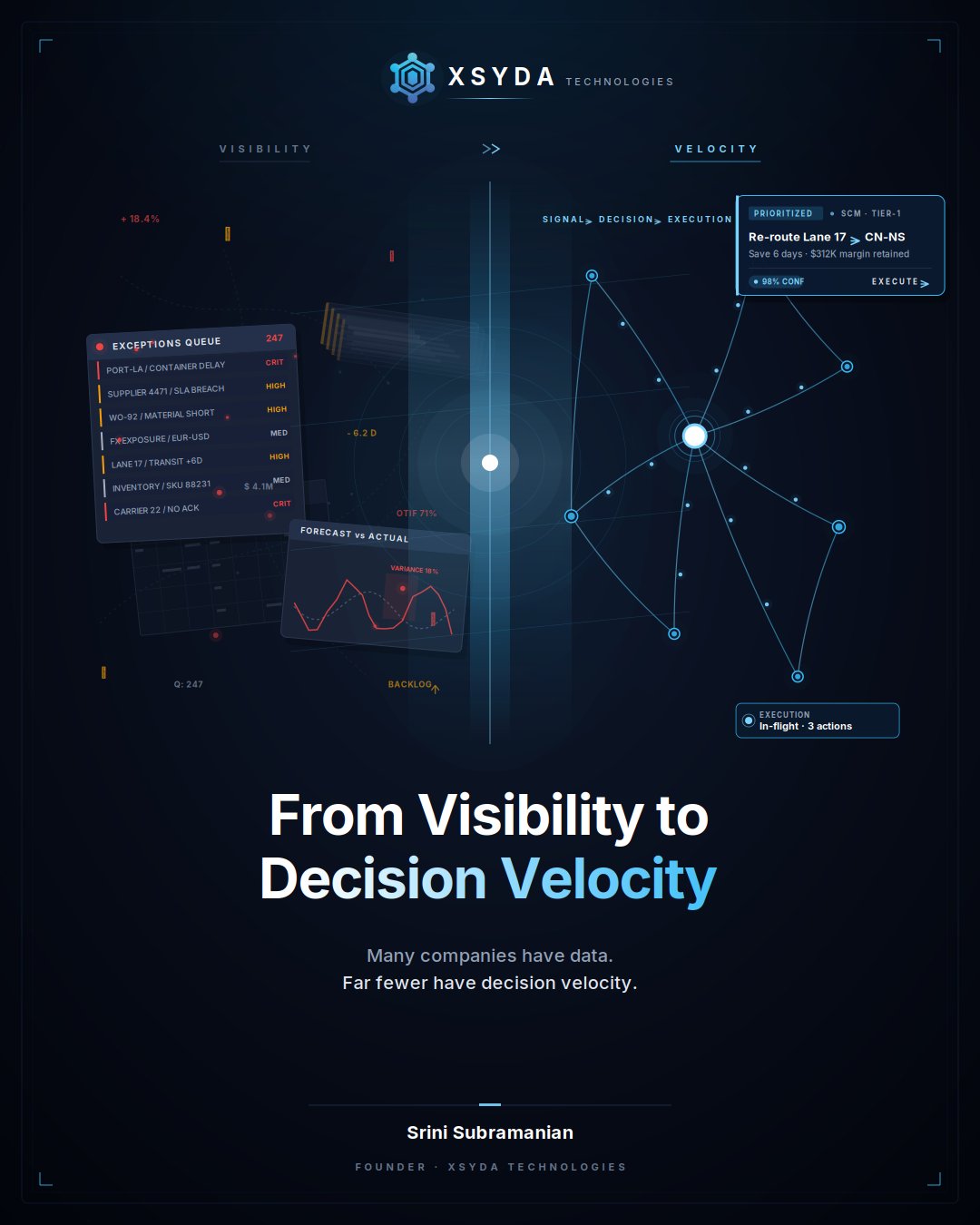
Most enterprises don't have an AI problem. They have a decision problem. Data platforms, dashboards, planning tools, and increasingly AI models all sit above operational reality — but the distance between an operational signal and a governed, executable decision is still crossed by people, spreadsheets, and time. XSYDA is the decision layer that closes it.
Signal → Engine → Decision → Governed Execution
One platform. Two AI engines. Four enterprise applications.
From enterprise visibility to governed decision execution.
XSYDA builds intelligent systems for complex enterprise and engineering environments. Enterprise Intelligence is our current commercial platform, connecting data, processes and operational signals to decisions and governed execution. Computing Intelligence is our research and product initiative focused on semiconductor intelligence and advanced computing.
Your enterprise already has data platforms, dashboards, planning systems, and increasingly, AI models and agents. What is often missing is the layer that turns changing operating conditions into governed decisions and executable action — consistently, at enterprise scale, with authority and audit.
AI initiatives generate strong prototypes and business cases, then stall at the handoff into live operational systems, controls, and workflows.
ERP records the transaction. BI reports the trend. Neither closes the distance between an operational signal and the decision an executive needs to make about it.
Demand, supply, supplier, tariff, contract, and financial signals sit in different systems. The people who need to act on them still spend most of their time reconciling.
By the time exposure is understood, options have narrowed. The cost of decision latency shows up in inventory, working capital, expedite fees, and missed windows.
Generic AI agents can draft, summarise, and suggest. They rarely operate inside enterprise policy, with lineage, escalation paths, and the authority to act on defined decisions.
Every new AI use case introduces a new governance question. Without a shared decision layer, each team rebuilds the same controls in isolation.
The XSYDA decision intelligence architecture is informed by three decades of enterprise operating experience across a range of complex industries.
Named client, program, and employer history is documented in the Leadership section below.
XSYDA combines a deterministic decision platform with specialised AI engines to convert enterprise signals into governed and auditable execution.
Enterprise decision intelligence infrastructure that converts enterprise signals into governed, explainable, and auditable decisions.
Turn inventory and demand signals into better operational decisions. XVORA connects emerging market signals to product design, sourcing, and production planning.
Designed to support
Lower excess and obsolete inventory · better inventory positioning · improved sell-through · earlier exposure detection · stronger working-capital decisions.
Turn fragmented supply and disruption signals into better supply-chain and procurement decisions. XELRA monitors operational and disruption signals across the global supply network.
Designed to support
Earlier disruption visibility · stronger sourcing decisions · better supplier intelligence · reduced procurement friction · improved network resilience.
XSYDA's research and product initiative for intelligent computing and semiconductor engineering, grounded in first-principles research into adaptive computation and memory-centric architectures.
Workloads evolve, and execution should too. XMCP observes each workload and reshapes routing, memory, precision and sparsity at runtime — then proves what it did. It carries the core computing architecture and research direction behind XSYDA's Computing Intelligence work.
Extending that work toward semiconductor engineering, XDESIGN and XVERIFY apply AI to design and verification intelligence — design intelligence, coverage, debug and verification closure — reaching into EDA-oriented software.
The full intelligent-system lifecycle spans data, process, models, agents, orchestration, decisions, and execution. This pipeline shows the operational runtime view — how a live enterprise signal moves from ingestion to executed decision under enterprise governance.
XSYDA transforms enterprise signals into governed operational decisions.
Enterprise systems, supplier networks, market signals, and operational telemetry are continuously ingested.
Specialised AI engines such as XVORA and XELRA detect demand shifts and supply disruptions.
The XSYDA platform evaluates scenarios using deterministic decision frameworks.
Decisions move through enterprise approval workflows and operational systems.
Decision recommendations include transparent reasoning and signal lineage.
Immutable logs track every AI-generated decision.
Approval workflows ensure operational control.
Real-time ingestion of operational and market signals.
XSYDA does not replace your systems of record. It works alongside them, closing the distance between operational information and executable decisions in the areas where that distance is most expensive.
Move from reactive dashboards to earlier visibility of disruption, better inventory positioning, and stronger continuity decisions across the network.
Bring category strategy, supplier signals, contract exposure, and commercial decisions onto a shared decision layer instead of splitting them across systems.
Tariff movements, sanctions, export control, and duty exposure translated into decisions about lanes, classifications, and commercial terms — not just reports.
Standardise how consequential operational decisions are made, approved, executed, and reviewed — across functions and systems.
Give AI agents the context, policy, escalation paths, and authority they need to act on defined decisions inside enterprise systems — with full lineage.
Where data residency, deployment control, latency, and governance constraints require intelligence that runs inside your infrastructure, not outside it.
Most enterprise AI platforms generate predictions. Enterprises do not operate on predictions. They operate on decisions.
Enterprise operations generate thousands of signals across supply chain, procurement, finance, and logistics systems. Most platforms cannot unify them into coherent operational intelligence.
Traditional analytics tools generate forecasts but leave execution decisions to human interpretation, creating latency and operational risk.
XSYDA converts signals into governed decision pathways with traceability, auditability, and enterprise-grade control.
For more than three decades I have worked inside global enterprises leading large-scale operational, technology, and transformation programs across manufacturing networks, global supply chains, and Global Capability Centers supporting Fortune-scale organizations.
Across these environments I observed the same structural failure repeatedly slowing digital transformation: decision latency.
Enterprises have invested heavily in data platforms, analytics systems, and digital dashboards. Yet critical operational decisions — in sourcing, supply chains, production planning, and global trade — still move slowly through fragmented systems and disconnected workflows.
The challenge has never been the availability of data.
The challenge is the absence of a governed decision layer that can convert enterprise signals into accountable, executable actions.
XSYDA was created to address this gap.
It provides a deterministic decision infrastructure where enterprise signals can be transformed into reasoned, governed, executable, and auditable decisions operating directly inside the organization's own infrastructure.
Alongside the platform, specialized AI engines address specific operational intelligence challenges:
XVORA focuses on Design-to-Demand Intelligence, identifying emerging demand signals and market shifts early enough to influence design, sourcing, and production decisions.
XELRA focuses on Supply Chain Visibility and Predictive Execution, monitoring operational signals and external disruptions to maintain production stability and logistics performance in volatile environments.
Together with applications such as Strategic Sourcing Intelligence, Supplier Risk Intelligence, Global Trade Intelligence, and Tail Spend Intelligence, these systems enable organizations to move beyond dashboards and forecasts toward governed, decision-driven enterprise execution.
Enterprise AI should not stop at recommendations.
It must deliver decisions that organizations can trust, govern, and execute with confidence.
That is the principle behind XSYDA.
Across three decades of enterprise engagements, Srini has held senior operating roles at Wheels India Limited, NRB Bearings, TATA Autoplastics, HTC Global Services, HCL Technologies, Visteon, Flex, and Wells Fargo — spanning industrial manufacturing, semiconductor operations, financial services, and global capability operations.
Client and program engagements during these roles have spanned the automotive ecosystem (Ford, General Motors, Toyota, Hyundai, Honda, Nissan, Suzuki, Yamaha), semiconductor manufacturing (KLA, Applied Materials), industrial manufacturing (Stanley Black & Decker), aerospace (Pratt & Whitney), telecommunications (AT&T), and publishing and information services (Gale / Thomson).
Semiconductor supplier-development engagements during operating roles at Flex included Broadcom and onsemi.
All trademarks and brand names are the property of their respective owners. No current customer relationship, partnership, or endorsement by XSYDA Technologies is claimed or implied.
Srini Subramanian
Founder & Chief Architect, XSYDA Technologies
LinkedIn →
Two multi-book series and six standalone works — on intelligence, capability, and the systems that hold them.
An Executive Briefing is a working session with the XSYDA team — a chance to examine a specific enterprise decision problem you are trying to solve, look at where existing systems constrain it, and discuss whether XSYDA's platform, XVORA, or XELRA could apply to your environment.